 Whippersnapper
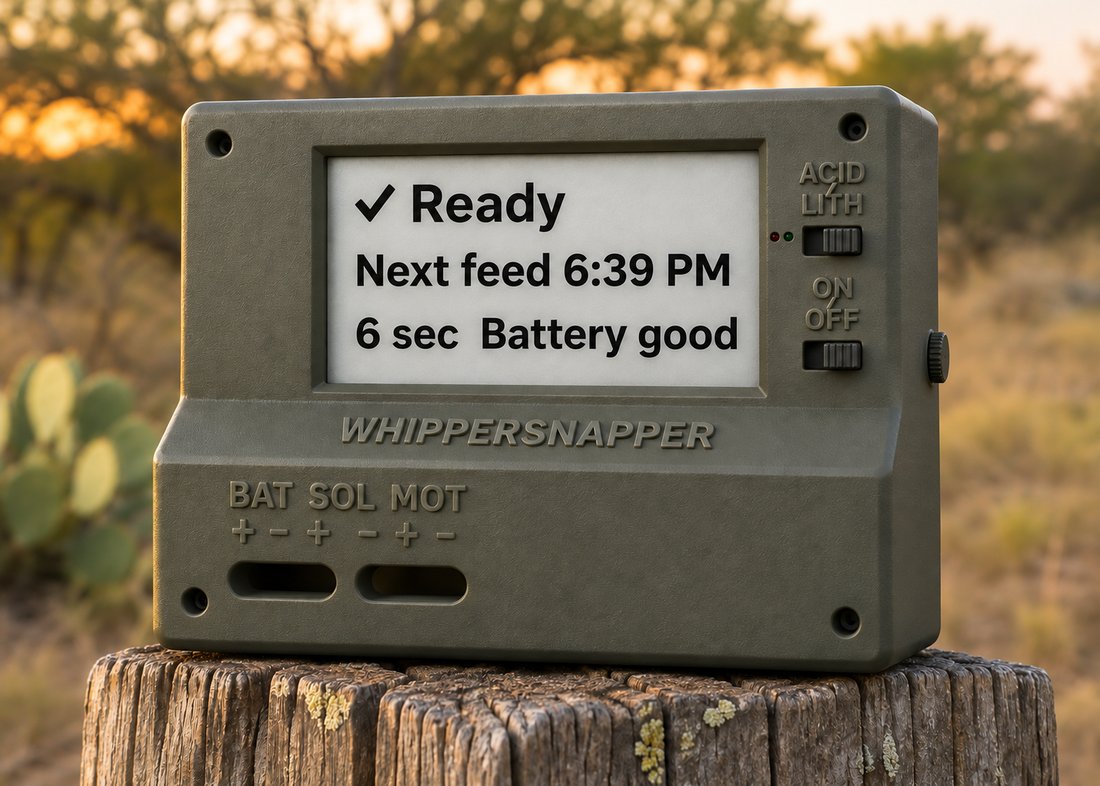
Solar charging built in
Charges the feeder battery from a solar panel. No separate charge controller to buy or wire.
GPS deer feeder timer
Wire it in and walk away. The Whippersnapper gets its location and the time from GPS satellites, then feeds by the sun every morning and evening, all year.
You've been here
Sunset moves. In December it comes more than two hours earlier than in June. A timer set in mid-September for 6:39 PM, an hour before sunset, is going off after sunset by December, when the deer you wanted at last light have come and gone.
So you drive out, open the box, and reset it. Again. Or you stand at the feeder trying to get a phone app to connect.
Or it's your dad's feeder. He still loves to hunt, but the tiny buttons and menus on today's timers have gotten hard for him to program, so the resetting falls to you.
“Apps don't work in the field. Period.”
Jeff, who built the Whippersnapper
Watch a year go by
Feed times for one year in San Antonio, Texas. Run your mouse or finger across the chart.
Keyboard: focus the chart and use the left and right arrow keys to step a week at a time.
Sunrise and sunset from the NOAA solar equations for San Antonio, Texas, 2027, Central time. The steps in spring and fall are daylight saving time: the clock timer is set once and never touched, so by your watch its feed moves an hour when the clocks change. The Whippersnapper feeds 15 minutes after sunrise and 1 hour before sunset wherever it's installed. See the feed times for your own spot.
The answer
A GPS receiver inside tells the Whippersnapper where it is and what time it is. From that it works out sunrise and sunset for that spot, every day. About once a week it checks the time against the satellites again.
No zip code to enter. No daylight-saving change to remember. No clock to drift.
The times move with the seasons on their own.
Setup
Battery, solar panel, spinner motor. Flip the battery switch to lithium or lead.
Turn the dial to set 1 to 15 seconds of spin. It runs one test feed when it powers up, so you know it's wired right.
Leave the feeder under open sky. The screen says Finding satellites...
In about five minutes it knows where it is and what time it is. From then on it feeds on the sun's schedule.
The screen
No blinking codes to look up. The e-ink screen reads like a note on the box, stays readable in full sun, and keeps showing its last message even with the power off.
Tap a situation:
Everything's normal.
Built for the box it lives in
Charges the feeder battery from a solar panel. No separate charge controller to buy or wire.
12 V LiFePO4 lithium, or 6 V or 12 V lead-acid. Lead-acid voltage is detected automatically.
Retries once, then stops and tells you. It also catches an unplugged motor or one that won't switch off, and never runs longer than 15 seconds.
When the battery runs low it drops to one feed a day, then pauses, and picks back up when the battery recovers. It won't charge lithium below freezing or above 50 °C (122 °F).
A coin cell keeps the clock running while the main battery is disconnected.
It will ship with a written warranty. We'll post the terms here before it goes on sale. Warranty length and terms
| Batteries | 12 V LiFePO4 lithium; 6 V or 12 V lead-acid (detected automatically) |
|---|---|
| Feed times | 15 minutes after sunrise; 1 hour before sunset |
| Feed length | 1, 2, 3, 4, 5, 6, 8, 10, 12 or 15 seconds (10-position dial) |
| Longest motor run | 15 seconds |
| Location and time | Built-in GPS, no setup. First fix about 5 minutes under open sky. Re-checks about once a week |
| Clock backup | Coin cell (CR1220 or BR1220) |
| Display | 2.66 inch e-ink, readable in sunlight and with power off |
| Lithium charging | 0 °C to 50 °C (32 °F to 122 °F) |
| Fuse | 7.5 A blade fuse in the battery lead built in or not |
| Solar panel | supported panels |
| Motor | compatible motors |
| Size and weight | final design not finished |
| Operating temperature | not yet tested |
| In the box | not decided |
Questions
No. There's nothing to pair, sync or sign in to. Not now, not ever.
Yes. It only listens to GPS satellites. It never needs a phone, a network or Wi-Fi.
It handles it. It works out the time zone and daylight saving from its location, so the screen always shows your local time, and the feeds follow the sun either way.
No. They're fixed at 15 minutes after sunrise and 1 hour before sunset. That's on purpose: nothing to set means nothing to get wrong.
The dial sets how long the spinner runs, from 1 to 15 seconds.
12 V LiFePO4 lithium, or 6 V or 12 V lead-acid.
Yes, from a solar panel. Panel requirements
For the first fix, yes. Set it up outside under open sky and give it about five minutes.
It tries once more, then stops and shows Spinner stuck.
Clear the feed, switch it off and on, and it's back.
It cuts back to one feed a day, then pauses feeding, and starts again when the battery recovers.
It wires to the feeder's battery, solar panel and spinner motor, and sits inside the control box. We're still testing how it fits inside different feeders' control boxes, and we'll post what we find here before it goes on sale. Motor and wiring compatibility
No. It works for its whole life as shipped. If an improvement comes out, you can plug it into a computer and update it from this website in Chrome or Edge. That's optional.
It's in development now and planned to be available by summer 2027. Join the waitlist and we'll email you once, when it's ready to order.

Meet the maker
I'm Jeff, from Texas. I've hunted since I was 9, and these days I hunt in Texas, Arkansas and Colorado.
I built the Whippersnapper for two reasons. My father-in-law still loves to hunt, but today's feeder timers, with their tiny buttons and menus, have gotten hard for him to program. And I don't live close to my hunting property, so every time the clocks change, my feeders run on the wrong time until I can get out there.
I wanted a timer you wire in once and never have to touch again. No buttons to puzzle over, no app, no clock to reset.
By trade I'm an aircraft mechanic. I've held an FAA A&P (Airframe and Powerplant) license for 25 years, and I have a master's degree in Aeronautical Science from Embry-Riddle Aeronautical University. I've spent my career on equipment that has to work every time, and that's how I'm building this.
Jeff
The waitlist
The Whippersnapper is in development now and planned for summer 2027. Join the list and you'll hear the moment it's ready to order.